
Your bill
Your electricity bill
Check out our guide below, which breaks down your invoice and explains what each section means. All your bills are available to view online via our customer portal.
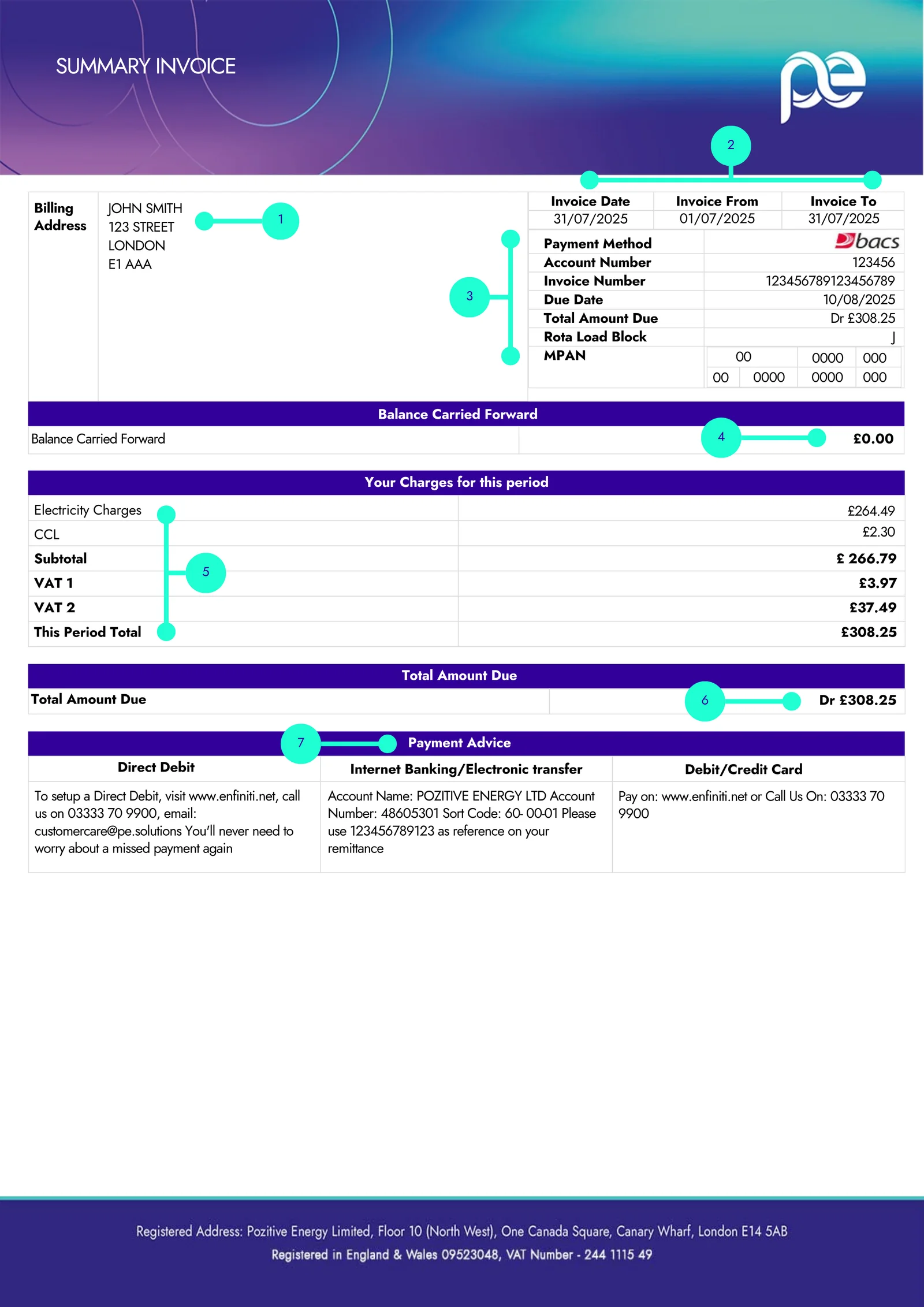
Sections 1 to 7
Page 1
Each number on the bill matches a section below. Select a section to read what it means.
This is the address you provided to send bills to.
Invoice Date is the date when the invoice is issued. Invoice From is the billing period start date. Invoice To is the billing period end date.
- Payment Method: Your agreed payment method. It will either be Direct Debit or BACS. BACS stands for Bankers’ Automated Clearing System and it is the electronic way of transferring money from one bank to another within the UK. It covers payments by card as well as bank transfers.
- Account Number: This is your account number, a point of reference when contacting us.
- Invoice Number: This is the invoice number.
- Due Date: This is the date when the payment is due, in line with your agreed payment terms.
- Total Amount Due: This is the amount due including any balance carried over from the previous billing period.
- Rota Load Block: Also known as “rota block disconnections”, “block letters” or “alpha identifiers”. This is your unique identifier in an event of emergency power cuts. They are typically scheduled on an area-by-area basis, with businesses typically losing power for a few hours for a pre-defined period. A lot of publicity surrounds such events. With reference to your Rota Load Block, you will be able to find out when your power supply will be disrupted, how long for and over what period.
- MPAN: MPAN means Meter Point Administration Number. It is commonly separated into two sections: the top line and the core. The top line consists of: Profile Class, Standard Settlement Configuration, and Line Loss Factor. The core is a unique 13-digit reference that consists of: Distributor ID, Unique Identifier and Digit Check.
This section shows whether any balance has been carried over from the previous billing period.
This section summarises your charges for this billing period, including CCL and VAT.
- CCL: CCL means Climate Change Levy. The CCL is a government tax designed to encourage business customers to use energy more efficiently and support the reduction of the UK’s overall emissions.
- VAT: Depending on how much electricity you use and the size of your business, you will either pay standard VAT at 20% or reduced VAT at 5%. Your invoice (page 2) displays this.
This is the amount due including any balance carried over from the previous billing period.
CR means that you have a credit balance, DR means that you have a debit balance.
This section explains how to make a payment.
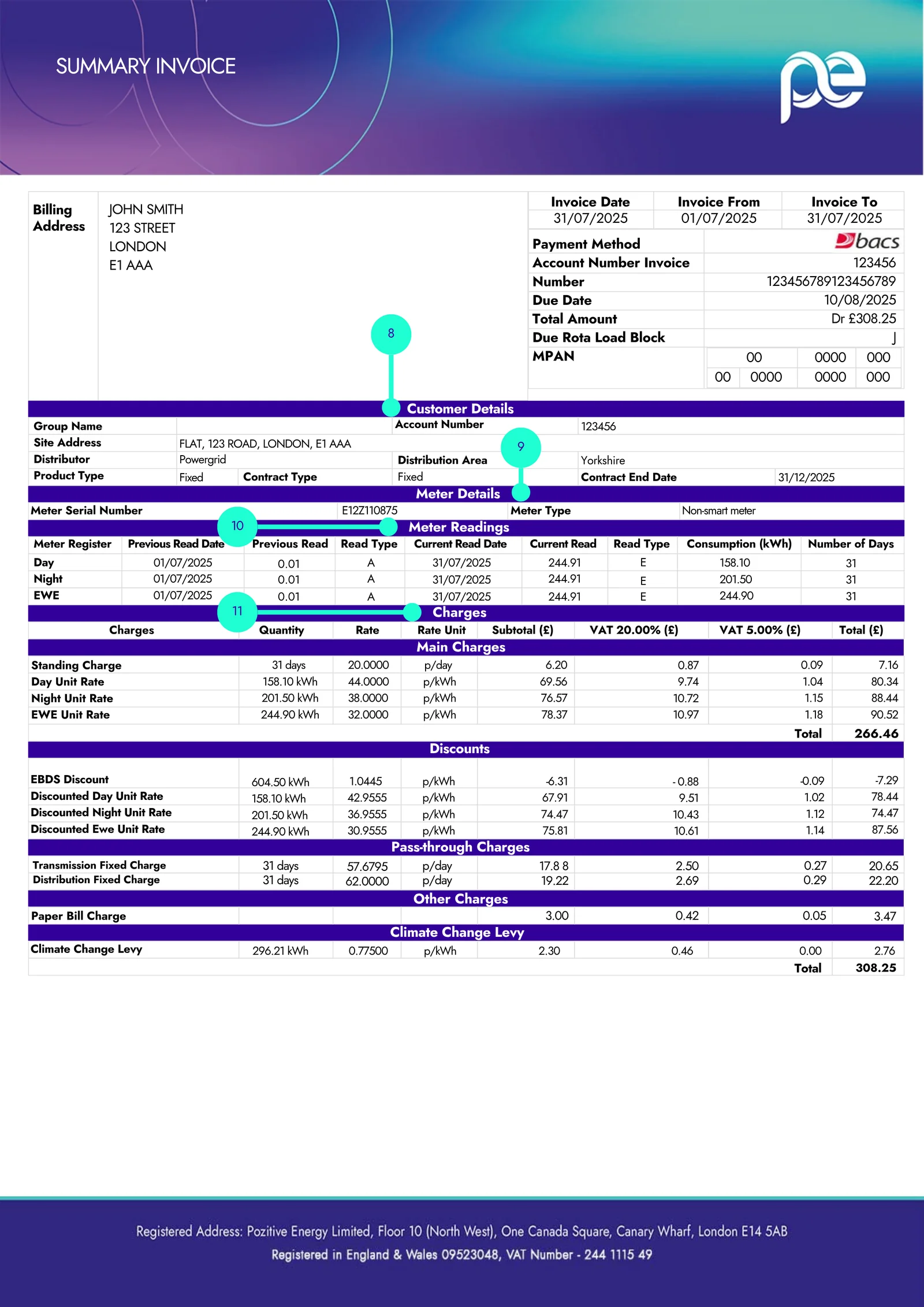
Sections 8 to 11
Page 2
Each number on the bill matches a section below. Select a section to read what it means.
This section provides key information about your account:
- Group Name will be populated if you told us that you are part of a group.
- Account Number is your account number.
- Site address is the address where we supply electricity to.
- Distributor is the name of the distribution operator operating the electricity distribution network in your area e.g. UK Power Networks.
- Distribution Area also known as “Region” is the name of the geographical distribution area e.g. London.
- Product Type is the name of the electricity product you purchased from us.
- Contract Type means the type of contract that you have with us. Contract Type can be Fixed, Out of Contract or Deemed.
- If your Contract Type is Fixed it means that certain components as per your contract with us e.g. Standing Charge and Unit Rate are fixed until the Contract End Date.
- If your Contract Type is Out of Contract it means that your fixed contract has ended and you have not renewed and you are on our variable Out of Contract Rate.
- If your Contract Type is Deemed it means that you are supplied by us but have not explicitly agreed a contract with us. This typically happens when you move in.
- Contract End Date is the date when your contract ends. If this field is N/A it means that your contract does not have an end date.
This section provides key information about your meter:
- Meter Serial Number also known as MSN is a unique number to identify an electricity meter.
- Meter Type means the type of meter at your premises. It can be Smart meter, Non-smart meter, AMR or Prepaid.
- If your meter is a Smart meter, it means that it is capable of remote communication and conforms to the Smart Metering Equipment Technical Specification.
- If your meter is a Non-smart meter, it means that it is not capable of remote communication.
- If your meter is an AMR (Automated Meter Reading), it means that it has a device attached to it that makes it capable of remote provision of consumption and diagnostics information.
- If your meter is a Prepaid meter, it means that you pay as you go for your energy.
This section displays your previous and current meter readings, your consumption during the billing period, whether each reading or consumption is actual (A) or estimated (E) and number of days in your billing period. Your meter may have one register or more. This section will display the information in relation to every register on your meter.
This section provides the detailed breakdown of your charges for the billing period. Your charges typically comprise of:
- Standing Charge – this is a daily rate that you pay.
- Unit Rate – this is the rate that you pay for every kWh you consume. Depending on the number of registers on your meter, there may be more than one Unit Rate.
- Discounts – we offer a range of discounts, and any applicable discounts will be itemised on your bill.
- Pass-through Charges – these are the charges that are charged to us by industry and in accordance with your contract terms we pass them through to you. Any applicable pass-through charges will be itemised on your bill.
- Other Charges – any bespoke charges as per the contract terms will be itemised in this section.
- Climate Change Levy.
If you have agreed a repayment plan, your bill will include a repayment plan section which will provide the detail of your agreed plan including the amount outstanding, collection schedule, agreement end date, rate of collection and payment method.
Charges Breakdown
Here we explain how different costs make up your bill. This breakdown is based on our typical customer which is a small to medium size business.
What do these costs mean and what makes them up?
- Environmental – Charges to fund environmental initiatives or regulations, such as renewable energy subsidies, carbon reduction programmes, or emissions trading schemes.
- Operating – Costs related to the day-to-day operations of providing electricity, including customer service, billing, metering and administrative expenses.
- Tax – Government-imposed taxes such as value-added tax (VAT) are based on energy consumption and the type of business.
- Third-party intermediary costs – Fees are paid to intermediaries who facilitate contracts or negotiations between energy suppliers and consumers.
- Wholesale – Cost associated with purchasing electricity from the wholesale market, where energy is bought in bulk by suppliers before being distributed to consumers.
- Network – Charges cover the cost of maintaining and operating the infrastructure to deliver electricity, such as power lines, pipelines, and substations.
How are these costs split across Standing Charge and Unit Rate?
- Standing Charge is the charge that covers the cost to maintain the energy supply network and metering. It is charged on a p/day basis.
- Unit Rate is the charge that covers the wholesale, network and operating costs. It also includes the cost of government environmental and social schemes. It is charged per kilowatt hour of electricity used on a p/kWh basis.
For the typical consumer, these costs are split as follows across your standing charge and unit rate.
Electricity Unit Rate Breakdown
Electricity Standing Charge Breakdown
Why has my bill changed/increased?
If you are on a fixed term contract your standing charge and unit rate will typically not increase. You may be charged a different unit rate for consumption over and above your estimated annual consumption as per the terms of your contract.
During your contract term you may become subject to new network charges or government levies. Such new charges or levies will typically be passed through to you and may see new pass-through charges on your bill. These new charges or levies are typically driven by government policy.
Network charges and government levies are updated annually. If network charges or government levies are passed through to you as per your contract terms, you may see an annual rate change on your bill. These rate changes are outside of our control. They are typically driven by government policy.
See our deemed electricity rates.
Further help and information for non-domestic customers on your bill
If you have questions on how the charges breakdown applies to your bill, you can contact us on customercare@smartpay.energy.
For further details on understanding your bills and the rules governing business energy supply contracts, please see:
- https://www.ofgem.gov.uk/your-energy-supply/how-manage-your-energy-supply/switch-your-business-energy-supplier (opens in a new tab)
- https://www.ofgem.gov.uk/your-energy-supply/how-manage-your-energy-supply/get-business-energy-contract (opens in a new tab)
- https://www.ofgem.gov.uk/your-energy-supply (opens in a new tab)